

You posted a video. It flopped.
You posted another. It went viral.
Which of these tells you what your audience wants?
Most creators answer this question emotionally.
People don’t like this topic.
My audience is dying.
The algorithm is out to get me.
This format sucks.
The best creators, however, answer this question using a different framework called Bayesian Thinking.
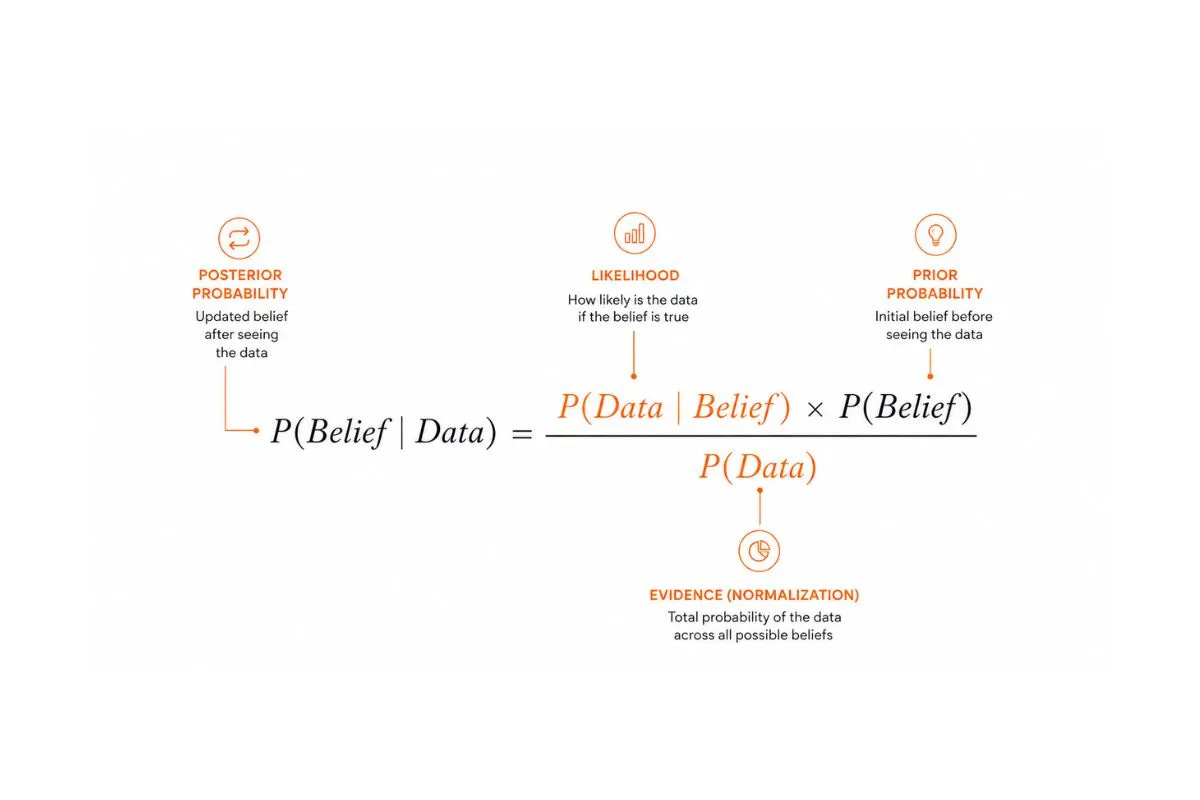
Bayesian thinking is a method of reasoning where you evaluate events by combining your prior knowledge or base rates with new evidence, constantly updating your degree of confidence as new information comes to light. Instead of seeing the world in strict blacks and whites, it treats beliefs as probabilities that shift incrementally
The Creator’s Reality Check
The first thing to realize is that -
One data point is rarely conclusive.
A video that got 800 views isn’t necessarily failing. A video that got 800,000 views isn’t necessarily succeeding. Both are simply data points that add to your understanding of your audience.
Bayesian thinking is really just a fancy way of asking given what I believe now, what should I believe given this new piece of evidence?
This one question can unlock exponential growth for any creator.
The Bayesian Creator
Let’s say you believed that your audience wanted practical AI tips. That’s your hypothesis.
You make a video about 5 AI tools that can save you 10 hours a week and it gets 5x more views than your average video. That’s evidence.
You can now believe with greater confidence that your audience wants practical AI tips. That’s an updated hypothesis.
You make another video about 3 AI workflows that can save you 5 hours of boring work. It does well too. Now you have even greater confidence in your hypothesis.
Your next video could tweak other elements like the type of practical tip, the presentation, etc. All while testing the same hypothesis.
How Creators Should Always Experiment
You should ask yourself what did this video teach me? instead of did this video work? Any creator experiment should have a hypothesis that gets updated based on the evidence.
You can use as signals to update your belief in a hypothesis:
What you tested What the evidence tells you
What you tested What the evidence tells you
Topic Does your audience care?
Hook Does this promise attention?
Format Does this presentation work?
Length How much depth does your audience want?
Thumbnail Does the idea create curiosity?
CTA What action are they willing to take?
Posting time Does timing matter for this audience?
You don’t want to make every post go viral. You want to make every post bring you closer to knowing what your audience wants. That’s the Bayesian way.
When Virality Is The Worst Teacher
This is where Bayesian thinking can be really useful.
Someone posts how they made ₹10 Lac with one strategy and gets 4 million views. You assume more money is always better and decide to post about money too. But you’re missing out on the real evidence.
The views were a result of the post’s virality, not its content. The person who made the post already had credibility with their audience. The thumbnail created curiosity. The views might’ve been driven by people who already cared about making money. You don’t know.
It’s better to study the hypothesis behind their post rather than copy their conclusion.
The Creator Hypothesis Loop
A simple Bayesian experiment for you.
1. Make a prediction
I think my audience wants beginner-friendly AI tips.
2. Create the experiment
You make 3–5 pieces of content around this hypothesis.
3. Study the evidence
Evidence goes beyond views and includes click-through rates, retention, watch time, saves, shares, comments, profile visits, followers gained, and conversions.
4. Update your belief
You realize that AI tutorials work for your audience. It could be that the topic is right but the hook is off. Or maybe it’s the format. Or perhaps your audience isn’t ready for it.
5. Run the next experiment
You don’t run the next experiment with empty hands but with all the learnings from previous ones.
The Most Common Creator Mistake
Reacting to small sample sizes with dramatic changes.
One post fails: this whole niche is bad.
One post goes viral: this is my new niche.
One person comments badly: this isn’t what my audience wants.
One brand DMs you: brands are the future of monetization.
This is the Bayesian way of thinking – small evidence should create small belief updates.
If one post failed, it doesn’t mean that the whole approach is wrong. It probably means that some elements of that post needed tweaking. If 10 posts failed, it could mean that the hypothesis is wrong. If 50 posts failed, you might want to consider looking elsewhere.
The Content Creator as An Experiment
You can look at your entire creator journey as a giant experiment.
Every creator has a set of beliefs about their audience. They believe my audience is like X, they care about Y, they don’t care about Z, this format works, this hook doesn’t work, people will engage if I do A, brands are a good monetization option, etc. All of these are hypotheses that must be tested against reality.
That’s what distinguishes great creators from everyone else – they never stop updating their beliefs based on the evidence.
Before you make any post, ask yourself:
My hypothesis:
I believe my audience will care about ______.
My experiment:
I will create ______.
My signal:
I will measure ______.
My result:
The evidence suggests ______.
My next move:
I will test ______ next.
If you do this religiously for a few posts, you’ll realize something interesting – you’re no longer asking what should I post today? but what should I test next? Because you care more about continuous improvement than short-term gains.
The best creators aren’t necessarily better at predicting the future; they’re better at learning from the present. They post, update, learn, re-post, repeat. That’s Bayesian thinking. Everything they do is an experiment. Every post teaches them something. That’s how they unlock exponential growth.
Don’t mistake your content for currency – it’s a laboratory. Every creator needs to think of their content as experiments so that they can learn from every interaction. That’s how you go from being a random creator to someone with a systematic content creation process.
For the next 5 posts, instead of chasing virality, you choose one element to test. You can test anything – the hook, the topic, the format, the CTA, etc. You write out your hypothesis before you make the post and update your beliefs once you see the results. The point isn’t to get 5 viral posts but to leave those 5 posts smarter than you were before making them.
What is one belief about your audience that you need to test?
That’s your next experiment.
